Guest Sermon
December 11, 2016
Rita Chamblin, Unitarian Universalist leader
“Witnessing at Standing Rock: Making the Invisible Visible”
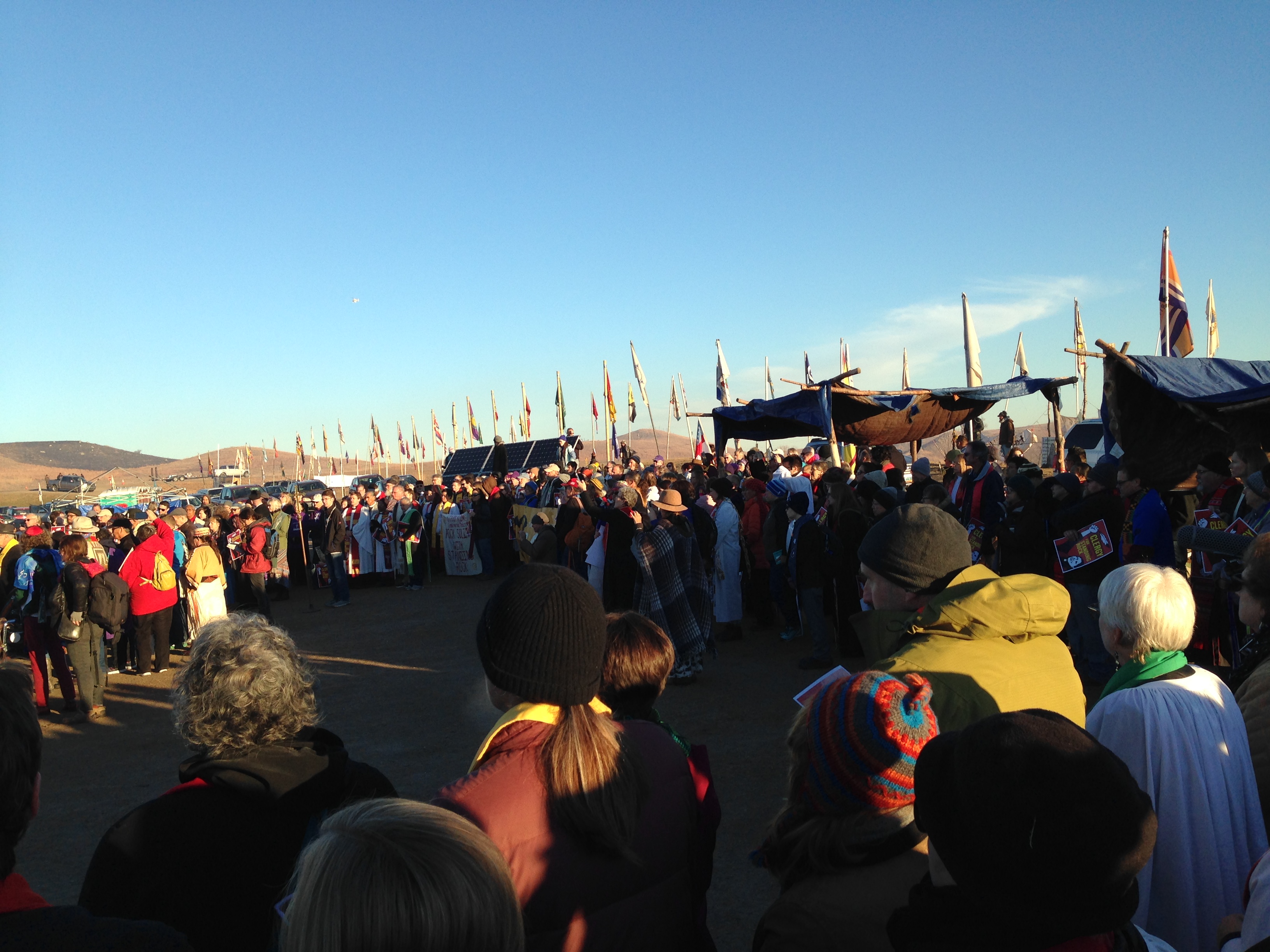
I drove to North Dakota. To Standing Rock. I went there to pray and stand in witness with over 500 religious leaders.

Standing Rock is the name of the tribe and reservation where Native Americans and non-Native allies have organized to resist the Dakota Access Pipeline, or DAPL. DAPL is designed to transport oil out of North Dakota and eventually into Illinois, crossing the Missouri River on treaty land, just north of the reservation. The river borders the reservation in both North and South Dakota.
I tend see the world through the lens of my own culture. Likely, you do too. Our family and circumstances, our own set of experiences. To us it’s just the way of the world. But, when we acknowledge and open ourselves to the differences of lenses through which others see the world, we can begin to build authentic relationships. And, then if we get our ego, and our individualism and our group identity out of the way, we can be changed by nurturing relationships with people who are different from ourselves. We can enjoy the learning that’s part of the experience. We can bear witness by listening to and sitting with another person’s struggles. And, to stay with it, when it’s uncomfortable, breathing deeply when it’s unsettling. That’s what I did last month, and I learned a lot.
Sometimes when we bear witness, when we listen to another person’s struggles, we find ourselves re-learning our history. Elders at Standing Rock spoke of the treaties between our government and Native Americans that were made and then broken, the most referenced being from 1851, The Fort Laramie Treaty. Boarding schools were established in the late 19th and early 20th centuries by our government to educate Native American children and youths according to Euro-American standards. Euro-American standards. White. As part of the government’s effort to hasten assimilation by suppressing native culture, Native ceremonies were illegal for most of the 20th century. American Indian spiritual practices were only protected by federal legislation in 1978. That’s less than 40 years ago. The Oahe Dam, constructed in the 1950s on the Missouri River, flooded 200,000 acres of the Standing Rock and Cheyenne River reservations. Over and above the land loss, most of the reservations’ prime agricultural land was included in the loss.
Why is there a resistance to this pipeline?
Elders and other Native speakers taught us local history, and reminded us that we were walking in a partnership with people who have felt that no one was listening to them. I learned that the area where the pipeline is approaching the Missouri River has been the site of many important events over the centuries for several Native American tribes. It is a sacred area in addition to having individual sacred sites. The example they used was to think of Gettysburg, where a large area is considered a memorial and we wouldn’t think to try to sort out each gravesite before trying to route a pipeline through it.
Elders and other tribal members are very knowledgeable about their treaty rights and the rules for the U S government to interact with Tribal government on issues of mutual concern. So they explained that the U.S. Army Corps of Engineers has failed to follow its own rules in permitting this project, opting instead to fast-track approval for the pipeline using rules in place for small projects – projects like a boat dock. They did this by breaking the pipeline project into lots of small pieces. So only limited local consultations were necessary. Standing Rock tribal council members schooled the DAPL reps who came to a council meeting back in 2014 about the need for a full assessment. The council also made it clear that the tribe had passed a resolution 7 years before that to deny projects of this nature on their land. In resisting this pipeline, the Standing Rock Sioux tribe and the Water Protectors are resisting the same forces of colonialism, land theft and loss of cultural identity that has played out since Europeans first arrived on this continent.
And, the environmental concerns? Environmental concerns exist any time a pipeline is laid and especially when it’s put under a water source. Elders referred to Mother Earth and the need to be in harmony with her. And Standing Rock has rights in the decision making regarding treaty land.
So, how do UUs fit into this? The UU church in Bismarck began engaging with Standing Rock at the Sacred Stone Camp, which was the first to be established as a spirit camp at Standing Rock in April. The Oceti Sakowin camp followed, as the numbers of people coming to support the Water Protectors grew. Oceti Sakowin means Seven Council Fires and refers to the proper name of the Great Sioux Nation. More than 200 native tribes have come to Standing Rock to support the Water Protectors. This is the largest gathering of Native American tribes in recent history. Indigenous groups from all over the world have also sent support.
Standing Rock is about an hour south of Bismarck. The UU church became a drop off point for supplies donated to the camps. The congregation not only donated and delivered supplies, they built relationships at the camps. They regularly spent, and continue to spend, days being present at the camp doing chores, joining in prayer, learning what’s needed and how best to be good allies to these neighbors of theirs.
Rev. Karen Van Fossan is the minister at the UU church in Bismarck. I’d seen her speak online for Church of the Larger Fellowship and Minnesota UU Social Justice Action about her and her congregation’s experiences at Standing Rock. This was one way in which she made the resistance to the DAPL pipeline visible. I’d been following the Water Protectors online since August, and really appreciated getting firsthand information and impressions from Rev. Karen. When Standing Rock and the camps asked for all people, including non-natives, to come support them, I began making arrangements to go there. I was already headed to North Dakota when the clergy call came and I’m grateful to have been able to participate in it, even though I’m not a minister.
Rev. Karen lifted up the clergy call to Standing on the Side of Love, who broadcast it to our association. UUA President, Rev. Peter Morales further amplified the call with his commitment to be present. What a great example of local relationship building giving us the opportunity to partner and become allies.
This is the shift that I think we’ve made in Unitarian Universalist justice making work. I saw it in 2010 when our Phoenix and Tucson UU churches had built strong and trusting relationships with human rights groups, Puente and NDLON. So, when Arizona SB1070, the “papers please” law was passed, we worked in partnership with these local organizations and knew how to support them. We participated, rather than led. I was at the 2010 General Assembly, our annual association meeting, when our response to SB1070 was discussed. And, I felt called to go to Phoenix to be on the streets on the Day of Non-Compliance when many UUs were arrested for civil disobedience. I think this model of building relationships and partnering, which has continued to flourish in our association, has increased our capacity for being good allies. For seeing the world differently. For showing up and standing on the side of love.
Our first out-of-the-ordinary experience was in just getting to Standing Rock. We were driving south from Bismarck on Hwy 1806, which follows the Missouri River. We drove up to a government blockade, which was supported by several large military vehicles along with lots of police/sheriff/state trooper/national guard vehicles. The gun wielding national guardsperson and the police waved us over, and curtly turned us around to find an alternate route. It was only later that I understood the geography well enough to sort out that the government had closed down Hwy 1806 on both sides of the area where the DAPL workers were laying pipe. The ACLU of ND called it a pre-emptive restriction of 1st Amendment rights. 1st Amendment rights include freedom of speech, freedom of the press, the right of the people peaceably to assemble, among others.
Non-violent, civil disobedience is central to our country’s history of social reform. It’s why I could vote on November 8th. Because women marched peacefully and engaged in non-violent civil disobedience for the right to vote over 100 years ago.
Native American leadership of Standing Rock and leaders of Sacred Stone and Oceti Sakowin camps have underscored that this is a prayerful and non-violent movement. In the middle of the Oceti Sakowin camp, near the sacred fire, are guidelines about the peaceful and prayerful nature of the actions.
And, Father John Floberg’s orientation, the night before our day of witness, included the direction that our day would be “Prayerful, Peaceful, Non-violent and Lawful”. Father John is the supervising Episcopalian priest for Standing Rock in North Dakota. He had hoped for maybe 100 clergy to respond to his clergy call. 524 clergy signed on to the official call, and we know more attended who hadn’t signed up online. Plus there were many lay leaders in attendance, bringing the total to maybe 600 religious leaders.
Our arrival at Standing Rock followed several difficult days of violence by the government against the Water Protectors. This was after the government closed the Backwater bridge with burned out vehicles. Consequently, Father John told us that he felt it necessary to walk over the Backwater bridge with his hands up to explain to the government forces what the clergy day of solidarity would be about. Essentially, he wanted to forewarn them so they wouldn’t respond to our presence with violence. It was a couple of weeks later when the government used water cannons in addition to mace, tear gas, rubber bullets, sound weapons and concussion grenades at that same bridge.
We arrived early on the clergy day of witness to deliver supplies and walk around.
Oceti Sakowin is an amazing community of people working and living together successfully and cooperatively. It’s a self-sustaining, peaceful, prayerful, and powerful place, led by indigenous leaders fiercely committed to one another and to the sacred earth. There have been thousands of people there at any given time, and we read that people coming to camp are expected to follow indigenous leadership, do chores and work around camp.
Everyone is expected to come prayerfully, communicate mindfully and follow the Seven Lakota Values of prayer, respect, compassion, honesty, generosity, humility and wisdom. People are also asked to understand this moment in the context of settler colonialism. And to recenter indigenous worldviews, practices and leadership.
Rev. Karen and others have reported that days at the camps of Standing Rock begin and end in prayer, with prayers over meals and at other times throughout the day. I like Rev. Dr. Lynn Unger’s definition of prayer as opening a door in your heart, so that love can go both in and out.
Our day began prayerfully, as well, and I felt love going both in and out at Standing Rock.
Clergy were in their full vestments. The red stoles on the Episcopalians, in particular, and others, signifies that it’s a witness. In addition to the Native American traditions, over 20 faith traditions were represented. It was the largest interfaith gathering I’ve ever experienced.
We were invited to the gather around the sacred fire, which you won’t see in pictures because we were asked not to take pictures of it. The sacred fire is tended day and night and is the center for ceremonies and communications. This was a special invitation, for all of we non-natives to be welcomed at the sacred fire. Women lead a water ceremony each morning, and invited us to participate. Two women came around the circle with a pitcher of water and poured a small amount in my left hand to drink and to moisten my face. It is a reminder that Water is Life. Mni Wiconi in Lakota.
Following the water ceremony, while still circled around the sacred fire, we were offered smudging for cleansing. Both rituals helped to keep me grounded in this very moving and different experience.
Father John led the renunciation of the Doctrine of Discovery with leaders of faith traditions, including Unitarian Universalism, who have renounced it. This centuries-old legal doctrine, the Doctrine of Discovery, that declared indigenous peoples subject to the Christian explorers who “discovered” them, is not just outdated, but wrong. And, its legacy has led directly to Standing Rock. It’s our view that the Doctrine of Discovery is a relic of colonialism, feudalism and of religious, cultural, and racial biases having no place in the modern day treatment of indigenous peoples. Father John said he believed it to be the first time that the Doctrine had been renounced in public, by faith leaders in the presence of Native American elders and leaders. The elders then symbolically burned a copy of the Doctrine.
We followed Father John out of the area of the sacred fire, out of the Oceti Sakowin camp, up to Hwy 1806 and down to the Backwater bridge.
Both as we were filing out of the area by the sacred fire, and as we left the camp to walk down the road to the bridge, we were again offered smudging of sage and juniper by local members of Oceti Sakowin. Now, it takes some time for close to 600 people to move through this process one at a time. People spoke or prayed or remained in silent contemplation. And, some sang. That’s when I became aware of the helicopter which had been flying over us. The rabbi’s were singing a beautiful song, and the sound of the helicopter rotors beat in counterpoint to their song of peace.
As we walked up the road to the bridge, we prayed. Then, with a background of the burned out vehicles blocking the bridge and armored vehicles and militarized police beyond that, we sang and prayed and heard stories of support for hours. We witnessed as one body. On sacred ground. To make this struggle visible. To bring prayerful, peaceful, non-violent witness to this struggle. To pray for Water Protectors and all who stand against them. To pray for peace and the end of violence. To embody love.
And, the government helicopters, aircraft and drones continued to check on us unabated.
We closed with what was called a Niobrara Circle, where we passed the peace to each other. We stood in a circle and one person began by turning to their left and offering, in the way of their tradition, peace to that person. The first person continued down the inside of the circle, followed by each person blessed.
Truly, there was a powerful peace that day at Standing Rock.
And, the government helicopters, aircraft and drones looked on.
In Rev. Wm. Sinkford’s recent article “The Dream of White Innocence” in the UU World Winter issue, I was struck by his point that we’ve embraced a smaller vision of Beloved Community than Dr. King intended. We’ve centered our vision on love and not struggle. So, there are times in our UU history when justice work has become hard, and we’ve pulled back. Dr. King would call that “sleeping through the revolution”. We looked away and didn’t stay “woke”. It’s hard, you know, staying woke. Yet, Sinkford says we have the opportunity to become a community of resistance that knows itself to be struggling to stay awake and aware. He says “resistance is what love looks like in the face of hate. Resistance is what love looks like in the face of violence.”
Can Standing Rock prevail? Yes, Standing Rock and its allies have gained a respite with last Sunday’s announcement by the Army that the DAPL permit to cross the Missouri River at the pipeline’s current location has been denied. And, this would be an easy time for us to look away, brush off the dust and move on. However, to become the community of resistance that Sinkford envisions, we must struggle to stay awake and aware. There are many unanswered questions in the Army’s permit denial such as the scope of the Environmental Impact Study, the tribal consultation process, the outcome of the lawsuit by DAPL against the Army Corps, how easily can any decisions made be reversed by the new administration in January and is the government prepared to use force to stop DAPL from drilling under the river without a permit.
Make no mistake – the Water Protectors are resisting violence – to themselves, to the water, to their sacred land and to their cultural identity. This resistance to violence is what love looks like.
I’m one of thousands of people who have borne witness to this struggle, helping to make it visible. I stand with Standing Rock. I stand on the Side of Love.
Amen. Blessed Be. May it be so.
– Rita Chamblin
"Witnessing at Standing Rock: Making the Invisible Visible"